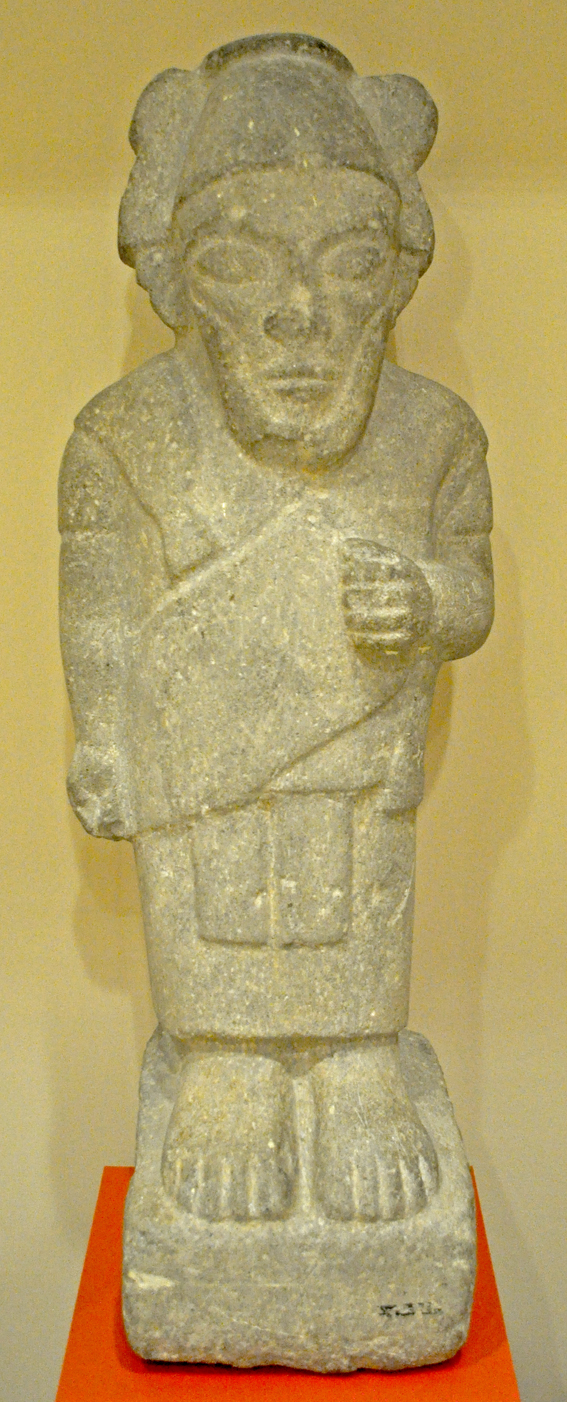
Statue of an Ammonite King
Statue carved of hard gray stone .The pose is right arm by the side with fist clenched, left arm across the stomach also with fist clenched. Wearing a shawl over a garment in the Aramaic-Syrian tradition, his legs are close together and he is standing on a pedestal. The depicted man is wearing an Egyptian style atef crown. There is no inscription on the pedestal but the formal pose, dress and crown indicate that this is a statue of a king.
The Iron Age saw the emergence of the first local Jordanian kingdoms: The Ammonite Kingdom in the north with its capital at Rabbat Amon (Amman); the Moabite Kingdom in the centre with its capital at Dibon (Dhiban); and the Edomite in the south with its capital at Bozra (Busayra).
These three kingdoms controlled one of the most important routes of the ancient Middle East, the “Kings Highway” that crossed the Jordanian plateau. This was not only a trade route for the exchange of goods but also of ideas and art.
Site: Amman Citadel
Period: Iron Age II, around 750 BC
Pictures Of Pieces