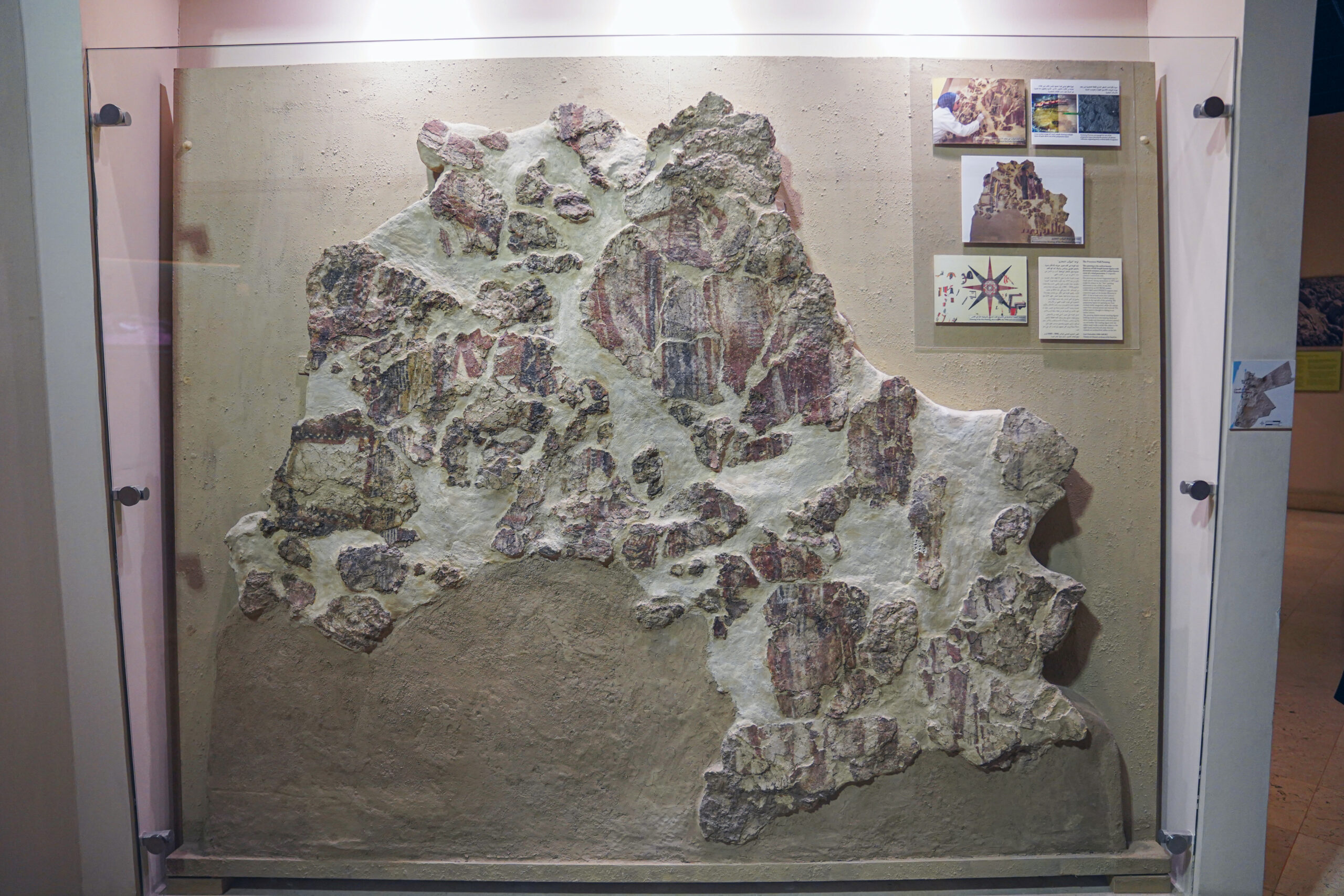
Tulaylat al-Ghassul Wall Paintings
One of the most difficult tasks for scholars is to interpret ancient works of art without any written documents. Art objects may provide us with a window into ancient beliefs, but our interpretations remain speculative.
The large wall paintings of the ‘Star’ and the ‘Procession’ discovered at the site of Tulaylat al-Ghassul are a particularly good example of art that incorporates many symbols, both in their direct use of the star, and in the scenes portrayed which show people wearing symbolic masks. The art is obviously full of meaning, but we cannot be sure if it was public art, or hidden for a select few.
The ‘Star’ painting has eight rays, and a motif probably of a butterfly and two masks. This painting could have symbolized the agricultural cycle that is often the basis for much belief: life, death and rebirth. The dark red and black colours of the
rays on the star could have been a representation of life and death, and the butterfly is often used as a symbol of life, with the chrysalis representing rebirth.
Fairly thin brushes were used to execute the finely outlined patterns of the figures in the ‘Procession’ painting, where three masked figures were depicted, it has been suggested that the figures are masked priests, probably symbolising vultures during burial ceremonies.
Site: Tulaylat al-Ghassul, Jordan Valley near the northern tip of the Dead Sea.